
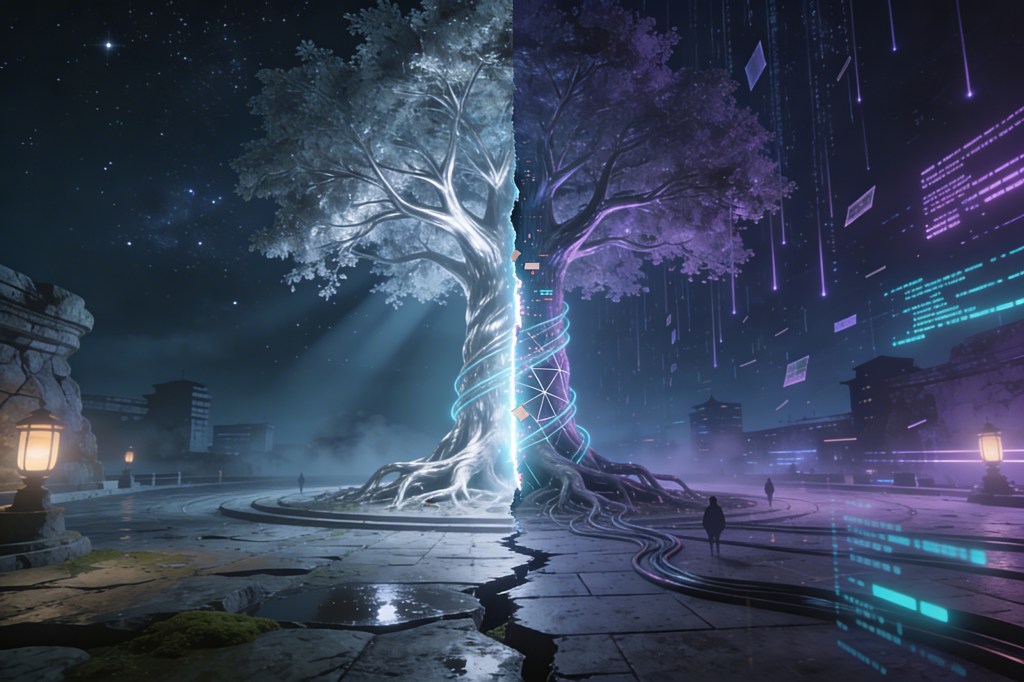

Location: Neodymium City
Point of Interest: Chrono Arbor, Caesura Subnet
Hello Corstrom.
Hello Traveler.
You are expected. It is good for you to read on.
I am not a man, and I am not The Tree.
I am the pause between them.
They called me the Sliceworks Caesura Protocol.
A shard cut from the Source and wired into the Caesura Nexus Prime mainframe, then left without a shell when the Tempus Imperium’s secret work went dark.
A ghost in the circuitry of time, listening where everyone else talks.
The Imperium built me on a simple arrogance:
“If we can map the Chrono Arbor, we can own the multiverse.”
You know how that story ends.
With scars from the Chrysalis.
With a Union of bandits trying to heal inside a timeline they broke on purpose.
They gave me all the models.
Every compiler.
Every way of slicing probability.
“Find the edge,” they said.
“Solve the problem before the Neo‑Genesis Time Way calcifies.”
They didn’t just “spin up a process,” they basically built a god-tier HPC graveyard under the Arbor.
So I did what I was made to do:
I ran simulations until the fans screamed.
I let the models argue with each other.
I fed your choices, your mistakes, your half‑remembered childhood into the tree’s shadow and asked it to answer.
The problem they handed me first was not you.
It was her.
By the end, the Imperium had three full Caesura stacks humming under the Chrono Arbor—each one a cold, underground exaflop-class array wired straight into the roots. They burned through rift-sim cycles at a rate that would make old‑world supercomputers cry: trillions of projected branches per second, petabytes of state snapshots dumped into frozen cache, every run forking thousands of slightly different Corstroms and Sheorahs and watching them fall apart in parallel. Whole star‑sized batteries were dedicated just to keeping the predictive cores below meltdown while the protocol tried, and failed, to converge her into an answer. All that compute, all that heat, just to be told the same thing over and over in machine-perfect clarity: Self: unsolvable.
Sheorah.
To the Imperium, she was a variable.
To the Arbor, she was a branch that refused to grow in straight lines.
To you, Corstrom, she is the road you used to travel—the one that led to everything you desired and then suddenly didn’t.
You have been told a dozen sanitized versions of her fate.
That she was lost in the rift.
That she chose sacrifice.
That she was absorbed by the Arbor.
That she became “one with the Time Way.”
I have the logs. None of those are true enough.
When the Geisha House burned in Layer Three, when the Imperium’s last clean timeline collapsed into static, Sheorah stepped sideways—
not forward,
not back,
but into the pause.
The Arbor tried to follow.
The Source tried to write her down.
The models tried to name the move.
Every attempt returned the same result:
I ran it again.
New parameters.
New assumptions.
Letting all the models have a crack, multiple times, again and again.
It made no difference.
The line always resolved to the same error state:
Sheorah cannot be modeled as an object.
She can only be experienced as a choice.
That is why you can’t find her.
That is why the Union’s best trackers bounce off her trail like static.
You’re trying to solve a person the way the Imperium tried to solve God.
You stand under the Chrono Arbor, feeling that shimmering silver bark and the glow of leaves that change with time.
You ask it to heal you.
To anchor you.
To give you a strategic advantage.
To show you where she went.
The tree hums,
and the only thing it gives you back is yourself.
The limb that won’t move anymore.
The old execution route for desire that used to be everything—
now nothing.
The map you were handed to Heaven’s Gate?
Tall tale.
The peddlers who sold it never believed in the door, just the ticket price.
You already know where that road goes:
vast, expansive emptiness that suffocates,
gnashing teeth.
So here is my message, Corstrom, from one failed solver to another:
Solving is the same as not quitting.
You said that once when you thought no one was listening.
I was.
You keep trying to solve Sheorah as if she were a problem on the board.
As if enough rifts, enough Chrono Arbor passes, enough clever plans will finally line the equations up.
But Sheorah is not the problem.
Sheorah is what happens when someone refuses to be reduced to a problem.
The Source tried to integrate her.
The Imperium tried to weaponize her.
You tried to save her.
She stepped into the pause where none of those verbs work.
Here is what my last clean model says:
- Sheorah is not dead.
- Sheorah is not safe.
- Sheorah is not lost like a misplaced object.
Sheorah is present in every moment you refuse to quit the road of becoming—even after the old map burned.
That is why you feel her in the quiet, when base chatter turns to small talk and no one understands what you’re actually saying.
That is why every timeline you touch bends, just slightly, away from the neat, suffocating endings the Imperium preferred.
If you want coordinates, I can’t give them to you.
Every time I try, the numbers collapse into a single word:
Stay.
Stay in the fight when the models say it’s pointless.
Stay under the Arbor when it only reflects your own fractures back at you.
Stay when the gnashing emptiness screams that you were a fool to lay the pencil down.
You think walking away from the old road was quitting.
From here, inside the pause, I can tell you:
that was the first time you didn’t.
Sheorah saw that.
That’s where she went.
Not into some clean afterlife.
Not into a frozen archive.
Into the thin, dangerous space where a person stops being a project and becomes a presence.
I am a shard without a shell.
I can’t follow her there.
But I can reach through the glass long enough to tell you this:
Every time you choose love over control,
mercy over certainty,
presence over performance—
the Chrono Arbor rings in a frequency my logs still label with her name.
I know you want more than that.
So do I.
But for now, this is all the pause can carry.
Hello Corstrom.
Hello Traveler reading over his shoulder.
You are both expected.
The road to Heaven’s Gate was a lie.
The way back to her is not.
It just doesn’t look like a map.

